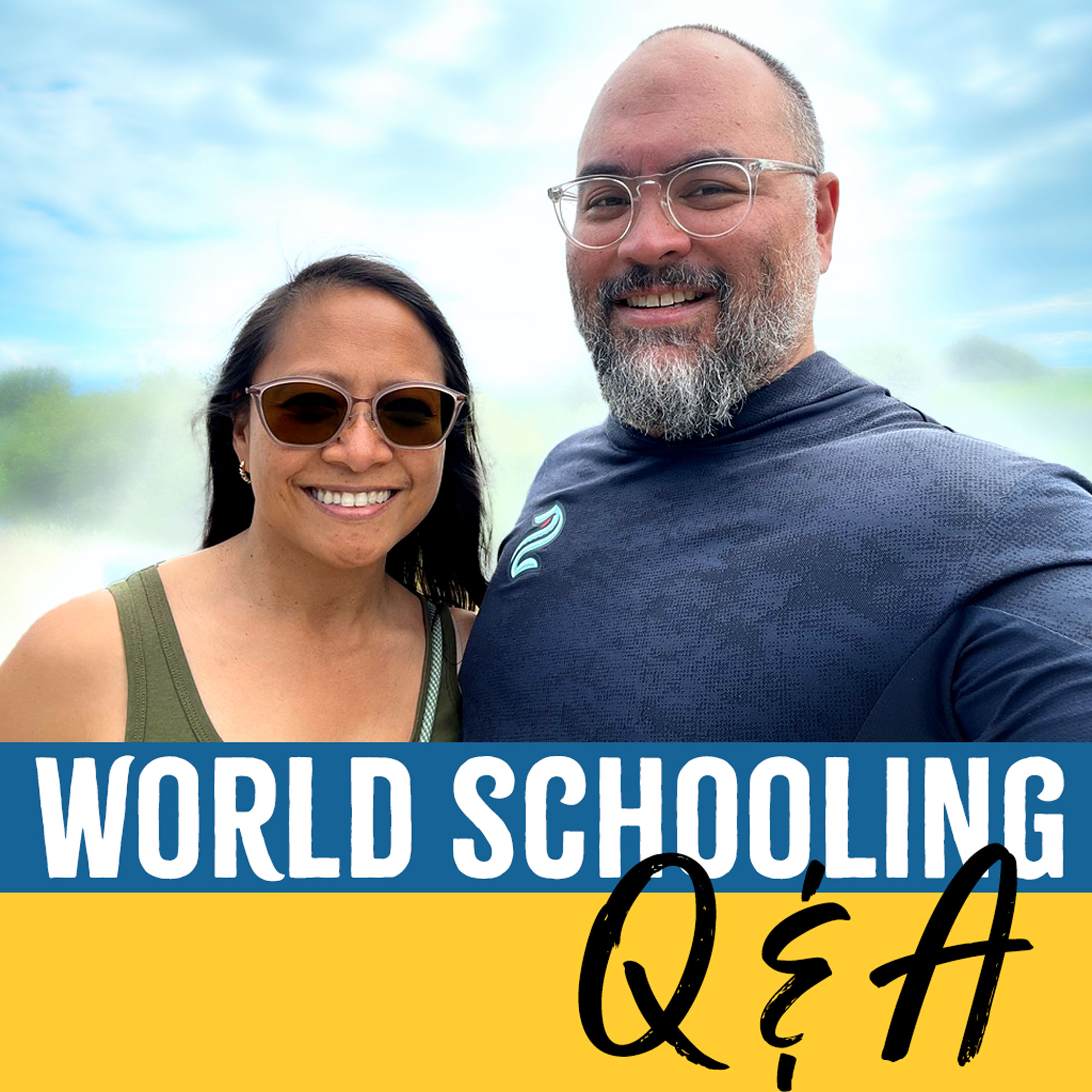
Suzy: Isn't this song awesome? This is original music by Maxwell Lee, our guest on today's episode. Maxwell shares the fascinating story of how he overcame his fear of moving abroad to launch a successful Anytime Fitness franchise in Taiwan and Malaysia, all while experiencing a personal musical renaissance. We dive into the realities of enrolling children in local Taiwanese schools, the intricacies of the Taiwan Gold Card for artists, and how he balances the demands of business ownership with his newfound life as a frontman and performer.
Welcome to Wonder World School. I'm Suzy, a travel-loving money nerd and mom of two. Our family lives between Spain and Colorado. Here, we discuss the stories, logistics, and finances of slow and long-term traveling families and the many ways to learn along the way. Don't miss listening until the end to hear another original music score by Maxwell Lee. Welcome to the show, Maxwell. Please tell me more about you and your family.
Maxwell Lee: I'm Maxwell. My wife's name is Kelly, and we have two boys, ages ten and seven. I was born and raised in Florida, but my parents are from Malaysia, so I'm Malaysian-Chinese-American. My two boys were also born in Florida, but my wife, Kelly, is from Macau. She moved to Florida when she was 11 or 12, around seventh grade. She was born and partially raised in Macau and then raised in Florida like me, so we consider ourselves Floridians. We moved around for a bit and finally settled in Taipei a little over three years ago. That's our background, at least geographically. Currently, we're expanding the Anytime Fitness brand here in Taiwan.
Suzy: I'm really excited to hear more about that because when living or traveling long-term, people often want to keep up with their daily habits, and fitness is one of those. It’s great to hear about your experiences with the fitness brand and what that has entailed for your family. Before we jump into that, I'd love to hear how travel influenced you growing up or what led to your desire to travel as a family now.
Maxwell Lee: I grew up traveling a lot, so I was pretty comfortable with the idea. My parents were both college professors and had summers off, so we would go back to Malaysia, their hometown, to visit their siblings and family quite often. We would also take trips to other parts of the world, so summer vacation was pretty typical every year. I also played music growing up, so we'd go to festivals and camps for my music. Because they were physics professors, they had science and physics conferences to attend and they’d bring me along for those as well. I really enjoyed going to new places and was very fortunate to have that experience.
However, I will say it's different from the idea of moving abroad. For some reason, I had a mental block on that. I always wanted to move abroad conceptually on paper, but I was afraid to. I didn't really put any plans in motion to do that throughout my young adulthood when it would have been much easier. Four and a half years ago, we were finally set to make that leap. Even though I was comfortable traveling abroad, I wasn't comfortable with the idea of settling or planning roots somewhere else. It felt scary and not very possible. It’s funny now that I've actually done it; I don’t know why I had this fear before, but that's how it works, I guess.
Suzy: When people travel, they often return to whatever home base they've been at. They get these unique experiences but with the comfort of knowing where they're going to return. When you leap out into the void for long-term travel or move abroad, it is a little more vulnerable because you're putting down roots and creating a home instead of just passing through. Your parents had great jobs for travel, having that built-in school schedule. You shared that your family launched from the U.S. about four and a half years ago. Tell me more about what those travels have looked like since then and how you landed in Taipei.
Maxwell Lee: It's a pretty storybook journey. I'm always hesitant to paint too rosy of a picture, but it’s really been exactly what we expected and hoped for. Our full-time travel piece was about eight months. We spent all of that in North America, with a good chunk in Mexico and Puerto Rico, trying to get a different experience and learn a new language. We also spent time in the U.S., traveling across the country to see friends and family as we prepared to move to Taiwan. We knew we were moving there the whole time; it wasn't a journey to figure things out.
We concentrated our time in North America to see friends before making that move to the other side of the world. We spent a month in Mexico City, a month in Mérida, and a month in the Cancún and Playa del Carmen area. I look back on those memories very fondly, as do my kids. We miss certain aspects of that freedom, but once we came to Taipei—which we love—we had to exchange some of that freedom for the benefits of settling in a community and planting roots.
Suzy: There are so many benefits to being in one place longer, especially if it’s somewhere new where you get that mix of travel and fresh experiences. What was the draw to Taipei? Was there a connection through family or friends, or just things you had heard that led to it being the next destination for your family?
Maxwell Lee: Since my wife and I met, we wanted to live in Asia. She was born in Asia but lost some of that connection and wanted to come back. We also have a good amount of family on this continent, so we wanted to be closer to them for a period of time. We talked about it when we first started dating and before we had our first child; we even considered going back to Macau to give birth to our first kid. Every year or two, there was a serious conversation about moving to Asia. Once we had both kids, we were determined to spend a few years somewhere where they could be immersed in the culture and language, whether that was Cantonese or Mandarin. We considered cities across the Chinese diaspora, including Hong Kong, Macau, and Singapore. In the end, Taipei was the most attractive city across the board.
We felt Taipei was the best fit for a family. We're big city people, and Taipei is very convenient, affordable, and offers great access to nature—which is something you won't necessarily find in many huge metropolitan areas in Asia. Taipei has greenery in every direction, and it’s very easy to get out to hikes. Within minutes by transport, you can be on several different hiking routes and feel like you're in a whole other world. You can see the cityscape, but the air feels fresher.
Suzy: That sounds magical—the mix of city life and public transit with easy access to nature. It’s helpful that you had traveled before and had that perspective. For your children, they left when they were much younger. I'm curious what their thoughts have been through this experience.
Maxwell Lee: My older kid considers himself a citizen of the world. He adamantly considers himself Taiwanese, Malaysian, American, and even Canadian because we have relatives there. He also identifies as Peruvian because of his great-grandparents who lived there. He feels it deep in his blood. He identifies as a worldschooler and fondly remembers those early days traveling and meeting other kids. He often asks when we can do another "worldschooling stint." My younger son doesn't remember as much specifically, but he loves traveling more than anyone in the family. He always wants to know when we're going somewhere. Sometimes we’ll come home from a two-month trip and, after a few days, he’ll say he’s "tired of this hotel" and ask where the next one is. Even though we’ve lived in the same apartment for three years, he still has that travel bug.
Suzy: It’s great to have kids who love to travel but also enjoy being settled in a community. Now that you've been in Taipei for a couple of years, what does schooling look like for your seven and ten-year-olds?
Maxwell Lee: They are in a local school here in Taipei. I got residency so that we could enroll them in a public school because we preferred that over a private or international school. My older son began first grade here when we arrived, and my younger son was in pre-K for two more years. The first three or four months were quite difficult school-wise because we were unable to prepare them for the language barrier. My biggest regret is not forcing them to get a basic understanding of Mandarin before we came. They were so resistant to learning it from us in the U.S. that we just let it go, assuming they would pick it up once we arrived. I wish I had insisted on some basic lessons so they could have made friends more quickly. It made the first few months rough, but by six months in, they were totally fine. Now that we’re starting year four, things are great.
Suzy: Thank you for sharing that. It’s not always sunshine and roses, and there are always hiccups when moving abroad. Regarding the language piece, what language is spoken in the schools and what do you speak at home?
Maxwell Lee: Growing up in Miami, their daycare was all Spanish-speaking, so they had some early exposure to Spanish. We also traveled through Mexico and Puerto Rico, so they had a little more exposure there, but it hasn't really stuck. My wife’s native language is Cantonese, and while they had exposure from her parents, that didn't really stick either. In Taiwan, the primary language is Mandarin. Many people also speak Taiwanese, but in the big cities, everyone speaks Mandarin.
Suzy: It’s great to give them that exposure early on. If someone is wanting to move abroad, they’re also thinking about how to make it work financially. You shared that you launched a franchise endeavor in Taipei. You’ve since grown Anytime Fitness to two locations in Taipei and one in Malaysia. Could you walk us through how that originated?
Maxwell Lee: Our background was in investing. We started with a real estate investment firm and eventually moved into investing in technology startups. My wife also worked for a VC firm. When we came to Taiwan, we didn't have jobs; we just came to figure things out. After about six months, my wife started looking into businesses she could buy, like coffee shops or restaurants. We were actually very close to purchasing a coffee shop that was doing very well. Instead, we considered Anytime Fitness because there was a location right on the path to my younger son's preschool. We walked by it every day, and eventually, my wife and I both joined. She took the initiative to reach out to corporate to find out how to franchise. We negotiated for a while but initially walked away because the numbers weren't good enough.
About ten months later, we looked into it again with a friend who had just quit her job. This time, corporate gave us a no-brainer deal. We opened the flagship location in the center of the city, and it did exactly what we expected. Later, we heard that Malaysia was the best country in Asia for Anytime Fitness, so I made it a point to visit every location there. We ended up opening a gym in Malaysia with the help of my family there. Now, we own the rights to all of Taiwan and raised a fund to build 12 more gyms. Currently, we have two in Taipei, one in Malaysia, and two more opening soon.
Suzy: If someone wanted to start a business in a country where they weren't raised, where should they start?
Maxwell Lee: Our journey was atypical because we weren't intending to do this at all. We fell into a franchise brand that originated in our home country, the U.S. I see many expats who open small businesses like restaurants to share food from their home. If there’s a brand you identify strongly with from home, it wouldn't be a big leap to open a franchise that already has a track record and a business plan. My advice is to be confident in the product; if you think it's a great service, it's worth looking into.
Suzy: You mentioned your music—how did that start and how has it continued while living in Taipei?
Maxwell Lee: It's been amazing and fulfilling. I studied music as a kid, majored in it, and even got a master's degree. I was pursuing music early in my career—teaching and working in management while performing pop and rock on the side. However, once our company took off, my passion for music fizzled out. It was always a regret. Years later, when we decided to live in Taipei, I applied for a Gold Card in the arts. I thought it was a 50/50 chance, but I was approved. It gave me a second chance—a renaissance—to get into music again. Over the last two years, I’ve performed more and worked with more musicians than I ever did in the U.S. I have my own band and feel very lucky.
Suzy: That’s such a cool entry point to Taiwan. What other fields are eligible for the Gold Card?
Maxwell Lee: It’s evolved, but generally, you can qualify through science, technology, architecture, law, or the arts. If you have a PhD from a top 500 university, you can also qualify. The Gold Card gives you residency and a work permit, which makes moving over much easier. However, I will say two things are a struggle in Taiwan: bureaucracy and banking. Getting my permanent residency has been a bit of a nightmare with a lot of back-and-forth and running around. Banking as a foreigner is also tough because of the many restrictions.
Suzy: It’s important to highlight those challenges. What instruments do you play, and what is your experience as a performer?
Maxwell Lee: I'm primarily a pianist and keyboardist, but I also play violin and guitar. In my twenties, I wanted to be a songwriter and composer—the backbone for someone else in the spotlight. This time around, I'm the frontman and lead singer. It’s been new, exciting, and nerve-wracking, but I've grown a ton by stepping outside my comfort zone.
Suzy: That’s so cool. If someone wants to spend a month in Taipei, what kind of price point should they expect?
Maxwell Lee: The trickiest part is housing. Airbnbs are extremely overpriced in Taiwan and exist in a legally gray area, which limits supply. Beyond housing, everything is very affordable. Long-term renting is great; we pay $2,100 US for a four-bedroom apartment in the center of the city. You can find much cheaper options further out—some friends pay under $1,000 US for very large places—but finding a reasonable short-term rental is the challenge.
Suzy: Before we wrap up, let's do a quick lightning round. What is the most unusual food you've ever tried?
Maxwell Lee: Maybe ants or crickets. Believe it or not, that was in Texas at a food innovation event during South by Southwest.
Suzy: One item you cannot travel without?
Maxwell Lee: My phone. It has my entire life in there.
Suzy: A favorite place or country?
Maxwell Lee: Vancouver, Canada. It's my son's favorite city, and we love it. We can envision living there someday.
Suzy: What is one piece of advice for a family considering moving abroad?
Maxwell Lee: My advice is to not wait. Based on my experience, I waited too long. Don't be scared and don't wait for no reason. Make sure you have a plan and do your research, but don't let fear slow you down.
Suzy: Where can people find you?
Maxwell Lee: My Instagram for music is Project Maximus, and my website is ProjectMaximusMusic.com.
Suzy: This has been so awesome. Thank you for sharing more about your life and your adventures in Taipei!
Maxwell Lee: Thanks for having me!