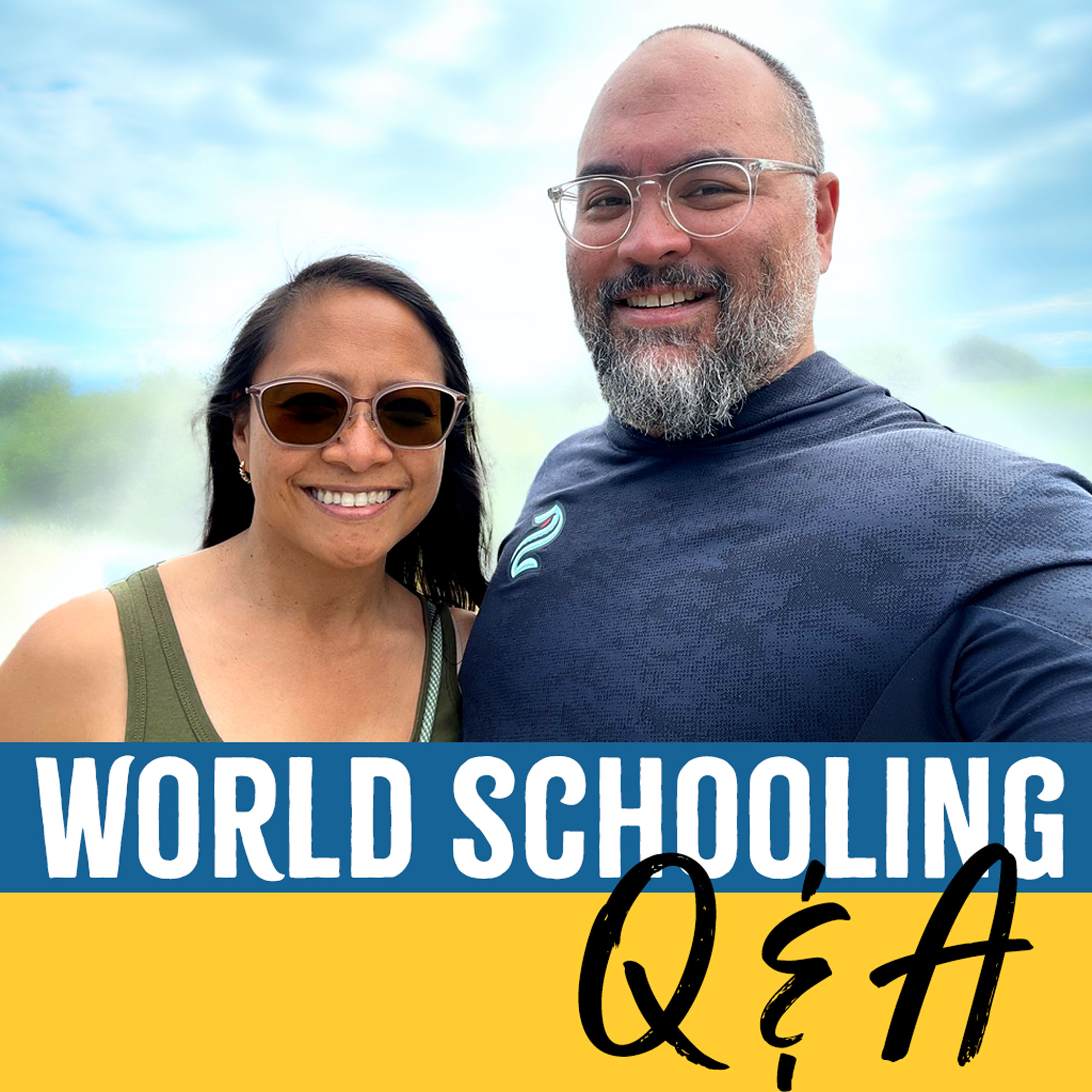
Suzy: Welcome to the Wander Worldschool Podcast. I'm Suzy, a travel-loving money nerd, mom of two, and our family lives between Spain and Colorado. On this show, we discuss the stories, logistics, and finances of traveling families and the many ways to learn along the way. Today, we get to know Astrid D’Vingy and Clint Bush. Tell me where you're calling in from and a little more about your family.
Clint & Astrid: Thanks, Suzy. We are calling from an actually unusually warm day today in Brooklyn, New York, in the US.
Suzy: Very cool. Give me a brief summary of the travels that you've taken as a family.
Clint & Astrid: We are originally from the Seattle area in Washington state in the US. We did do some full-time travel from 2018 to 2022. And then we went back to Seattle, and that was where we were living for the past three years until 2025 when we decided to move across the US to New York City. So we were full-time, like Astrid said, we were full-time travel for a few years in which case we visited mostly Southeast Asia, Europe, and Mexico. Yeah, tons of Mexico. We came back to the US, we settled back down there in the Seattle area to be with the family.
Suzy: And how old are your kiddos now?
Clint & Astrid: Right now they are 15 and 12.
Suzy: Okay, cool. And then we'll also share more about your podcast because if people are wanting to learn more about worldschooling, that's a great place to start with the Q&A sessions that you have. I'd love to hear more about where travel started for each of you.
Clint & Astrid: I was born and spent my childhood in Indonesia. My dad is American, so we would go back and forth. Growing up as a kid, international travel was part of my childhood. So I knew when I became a parent, I really wanted to continue that travel tradition. Yeah, for me, it was completely domestic. I grew up in Colorado in a tiny, tiny town, and then I went to high school in the Florence/Cañon City area. I'm south of Colorado Springs, and then I went to college in Greeley. We road-tripped a lot as a family, and that's where my travel bug started. And then after college, I took two and a half months and did a train trip across the US. That was the biggest step for me. I ultimately ended up moving to Seattle after that trip. And then six years later, I met Astrid. We flew to Italy, and that was our first international trip. I was completely hooked.
Suzy: When was your Peace Corps time, Astrid? Was that...? Yeah.
Clint & Astrid: Oh, that was from 2004 to 2006. And then after the Peace Corps, I traveled solo or with some friends around Southeast Asia and then did a road trip around the US. Yeah, road-tripping actually has become one of the ways we worldschool too because we almost always rent a vehicle of some sort when we're traveling and exploring a lot. Like we spent a lot of time in Southern Spain—three months in Southern Spain in La Herradura. But then we road-tripped—we had a car the whole time. So we went all through Southern Spain: Cádiz, Córdoba, Granada.
Suzy: Very cool. Did you have to learn a language when you were in West Africa?
Clint & Astrid: I just learned French. And then when I was in my village, I did learn some basic greetings in the local language. But I also recognized that understanding French would be a little bit better for me for travel later on. So I really just focused on learning French.
Suzy: Very cool. You started to give me a little bit of a rundown of the family travels that you've taken. Fill me in on what that looked like as you guys started traveling as a family.
Clint & Astrid: Our introduction to worldschooling was we had gone to a conference in BC, Canada, near Vancouver, and it was a family travel conference. It was put on by a few full-time traveling families. And so we had just bought a house, and we went to this conference and we were talking to everyone, and every excuse that we had not to travel, someone had an answer to it. Literally on the drive home, we were like, "Yeah, let's do this." And I think this is cool—before you ended that conference, they said, "Hey, if you sign up for next year's conference, you get a massive discount," and the next year's conference was in Mexico. And so we were like, "Well, we've never been to Mexico." And so we signed up for Mexico. And then on the trip home, we were like, "Yeah, let's do this." We started basically planning over the next nine months for our full-time travel. So we started in Mexico—we stayed six months in Mexico—and then we went to Europe. Italy, we figured that was a nice kind of interim place, and France. Then from there, we went to Southeast Asia because she still has family in Jakarta. We wanted to go to the Philippines. There were lots of reasons for us to be in Southeast Asia. So we kind of based it around seeing people we knew, and then the pandemic hit. So we were in Southeast Asia when 2020 came around. So because the next year we were thinking like, "Okay, we will go to Africa." Yeah, that was the goal. And then the pandemic hit.
Suzy: You're about two years into full-time travel by then. Okay.
Clint & Astrid: And we just went back to the States because everything was so many logistics and complicated. Yeah, like all the testing and the visas. Yeah, the restrictions. Once 2020 kind of settled down, we went back to Mexico in 2021, and then we traveled to Europe again. So our travel shifted to like, what were the countries that were open or that we could still travel through safely? Mainly stayed around—we did the UK and Spain. Yeah, we were also slowing down our travel. So when we first started our travels, we were in Mexico for six months, but I think to people who don't travel full-time, that doesn't seem like—that's like, "Well, that's a long time." But once you start traveling full-time, a month is like nothing. That second stint around, we tried to slow it down a little bit. We did more house-sitting. We stayed in smaller towns. Well, and something that our son had said—so he was, when we started traveling, he was like five—when he was like seven or eight, he was like, "You know, Mom, I feel like when we stay somewhere for a month, like just as I'm getting used to a place, then we have to go again." So we really took that to heart in terms of picking places or, when we travel now, it's like, "Okay, if we are going to fast travel, we'll let them know and kind of give them some downtime too." But then if we're going to be slow-traveling, you know, we just make sure that we stay in one spot and we allow them to sort of acclimate at their own pace to the place that they're at.
Suzy: You bring up a really good point that as kids get older, they have more opinions sometimes, which I think is a cool thing about travel. As they get older, they can experience more and be part of the planning even sometimes and where we want to go. So you mentioned that your son was looking for maybe a little change of tempo, but overall, what has their thoughts been when it comes to that full-time travel that you all did for those couple of years?
Clint & Astrid: So what's really interesting for us is last year was a big full-circle moment for us because we had come back to the US and been pretty stable for almost three years. But last year, what was different is we went to Budapest. There was a worldschooling hub there, and there was a big prom event and our daughter was the right age. And we reconnected with so many of the worldschooling families. Because that was the one thing—we built community while we were traveling full-time. I mean, all these worldschooling families, these full-time traveling families. And so we reconnected with them. Myra, our daughter, really got a lot of autonomy. Because where we were staying in Budapest was kind of central and there were a lot of teens. So we let her basically hang with the teens every evening. It was kind of a full-circle moment where she realized she loved that experience and that travel and the people there. And Julian really likes traveling. He likes being out and seeing new cultures and stuff. But then they also realized like the things that they love about being stationary and being in school. Because when we're here in the States, we don't homeschool. They're in school. And so it was kind of cool because it was like, "We're back in this lifestyle a little bit," both kind of traditional life, quote-unquote, and worldschooling. So that's been a fascinating adjustment and shift. Not always easy, I think, for us as parents because if it was me, we'd just go full-time travel again. I think that's the biggest lesson or the biggest thing we gained from traveling full-time is the communication and taking time to listen to what everybody's needs are, and we operate in a more democratic way. So like the kids have a say and we have a say and we talk through decisions instead of like one person sort of dictating to the rest of the family.
Suzy: And travel gives many opportunities to have those conversations because every day it's a new this or that. And so it does really encourage a lot of family conversations. And when you were full-time traveling, tell me a little more about what education looked like.
Clint & Astrid: So we homeschooled our kids when we were traveling. And I think I would say it's like eclectic unschooling, actually, because we did follow a curriculum sometimes, but not like any set curriculum. Like a typical day we would have the kids do some independent reading, practice Duolingo. Maybe we'll watch a video about a place that we're at, like a historical video or geographic video, and then we talk about it or we'd watch some science videos. Clint would assign them some math lessons. Just math, yeah. But most of the learning was like, "Hey, we're going to a museum," and we'll experience it and then maybe we'll talk about it later. Maybe it's like we are doing a zip line through the canopies in Costa Rica or something like that, or we're going to go swim with whale sharks. We really just used our experiences as the basis of the learning as opposed to just like, "Okay, let's open up this book and let's read this chapter in the book." We do this here in the States too, in the cities that we live in, like there's so much culture around you. There's so much history in the cities that we live in that people just take it for granted. But yeah, I think that was the most of how we learned was just through experiences. And then the math and the reading—all that stuff came. Like our son didn't read when we started traveling and he reads fine now, and they did math and we put them back in school and they're like ahead of their classes. So we're like, "Well, something worked."
Suzy: Yeah. Can you expand on that? How was that transition back for the kids?
Clint & Astrid: We were worried too. I mean, to be honest. I mean, the school system, especially in the US—or I mean, we'll just speak to the US—when you're in the school system, they make you believe it's the only system. Like that you cannot do anything else outside of the school system to be successful. And that's not true, for one. But even coming back, we're like—we were worried because we're like, "We've been out of the school system for four years." Our youngest son had never even been in school yet. And here he's going into elementary school, like I think third grade. We weren't really worried about them meeting friends because one thing we realized as we're worldschooling and traveling, they became adaptable. Other kids would be around, they would adapt to situations, they would play, they'd reach out. Even our son who's a little bit more introverted, he's still like, he'll go join a group of kids playing or something. Once they started school and the academics actually started, they both did incredibly fine. It was easy. The one thing that was a huge challenge was being reminded of how much our school systems rely on homework and how much stress and emphasis they put on busy work. And that's actually been a constant frustration of ours since we've gone back to public school. There's this false urgency in the intensity of the amount of work that they should be doing at this age. It's been challenging as parents, I think, coming back to it. Yeah, I think the mentality in the schools is like, "If you're capable or if you're smart, you should be able to do more work," and more work equals more learning instead of like, "Why don't you actually encourage them to do more thinking in a more advanced way?" We just realized we do more of on a daily basis in life that we don't teach in the schools at all. I feel like compared to their peers as well, our kids are more critical about what's being presented to them. Travel just exposes you to different perspectives. So maybe there's no one right way. So I think they've carried that into the rest of their life.
Suzy: Absolutely. Some of those things just cannot be taught in a classroom in the same way, for sure. And well, thank you for sharing the experience transitioning back because what I hear from that is that there are ways to help support your kid through that transition and that kids have time to adjust and catch up and that probably wherever they're at is where they should be. And just because school might feel a little different, you know, doesn't always mean that they're behind or anything. It just means that we need to adjust and that there's plenty of time to do that when transitioning back into a school environment or whatever the next steps are. What does languages look like?
Clint & Astrid: You speak multiple languages? We try to learn a little bit of language in other places that we go. So we learned a little Portuguese, I know a little bit of Indonesian, our daughter's learning a little bit of Indonesian, our son's learning a little bit of Japanese. It's not that we speak multiple languages as a family, but we all have a passion for language, I think. Yeah. And whenever we go somewhere, we do try and learn how to say hello, how to say thank you. One thing I always like to learn is how to say, "It was delicious" or "It is delicious." When we were in Japan a couple of years ago, I learned like, "It's delicious" is oishii desu. And so then every time I'd go to a restaurant and like I'd be walking out the door and be like, "Oishii desu." And then they're like, "Oh, thank you." I feel like it is a little bit of just a sign of respect instead of like assuming that everybody has to speak English all the time. I do. Everyone in the US should be bilingual, though. I absolutely think we should have at least one other language.
Suzy: Yeah, but...
Clint & Astrid: That's what we hope for our kids is just like, they already have a passion for language. They're interested in it. We tend to take language classes when we're in longer stays.
Suzy: And I 100% agree. Like we should start way younger with languages in the US. I think there could be multiple advantages to that. I only had to do two years in high school and like one half a year in middle school. So I did Spanish and I did three years of German. But by the time you're in high school and it's not really a priority because you got 17 other things going on. But if you start younger, it really can make a difference. So I 100% agree. Every family is like, "Okay, this sounds amazing," but they're wondering about the financial and the logistical side of the journey. What did that look like before your big long-term trip?
Clint & Astrid: At the time I thought, "If I'm going to be traveling full-time, I have to have hundreds of thousands of dollars saved" and blah, blah, blah. I did end up quitting my job, but Clint stayed on and they let him work remotely. And so I think it's much easier now to negotiate a remote work situation if you're already employed to be able to work. I ended up getting a remote job in 2020 as well. Then for the second half of our full-time travels, both of us were working remotely. And the other part was we had a home. Instead of selling it, we decided to put it up for rent, partially because like the housing market in Seattle, it would be stupid for us to sell because then we wouldn't be able to afford to come back to it. So again, if you are a family and you don't have the savings to do it—to travel full-time—you don't necessarily have to quit your job if you can find a way to continue your job remotely and you don't have to sell your house. You could potentially just put it up for rent if you have if you own property. So it seemed like everyone has a different financial story. So like every family we met, they had a different way of doing it. And I think that was encouraging. We read all the Facebook groups, the worldschooling groups. We asked questions all the time. And that was one of the reasons we started our podcast—was like, people have so many questions about this and we're speaking from a point of privilege, too. I understand not everyone is in a situation that can be easy for them. But we had someone actually reach out to us a couple of years ago and she was just like, "I want to do this. It sounds fascinating, but I'm in a job. I'm a single mom. Like, I don't understand how we can do this." And she actually just messaged me like two months ago and she's like, "I have a remote job and we just left to go to Europe." I was like, "That's awesome! Like, cool." If you're motivated, there's opportunities there. Sometimes you have to be creative, though. Nothing about this is easy, nor should it be. I mean, it's traveling. At least in my opinion, the point of travel is to kind of force you to adapt and learn new cultures, and that makes you uncomfortable. You don't grow unless you're uncomfortable. It's not going to be easy, but it will be rewarding if you can get through it.
Suzy: Right, it takes effort. It takes planning sometimes. Maybe you can't take off on a longer trip today, but you could take a test trip and try out the lifestyle a little bit. And like you said, set up the systems to rent your house out or whatnot. And then as you build more confidence, you can take a longer trip or as you find remote work or build up some other financial reserves or whatnot. And I always like to share that one-month spending snapshot. And I see you shared a little bit more about your time in Portugal.
Clint & Astrid: We ended up renting an apartment and so part of that—it was a short-term rental, too. So that's obviously going to be higher. So our lodging was more inflated than normal.
Suzy: And what time of year was it?
Clint & Astrid: Yeah, fall. It was shoulder season. It was beautiful.
Suzy: Okay. I bet those are great months, though.
Clint & Astrid: We also picked a location that was a little bit more central to everything. And because we work remotely, we wanted a place that had space to work and decent internet. Lisbon specifically we spent, I think, 3k a month on rent. Right. For those two months, it was about six thousand for those two months. I want to say for food, it was maybe up to $2,000. Groceries seemed a lot cheaper too—maybe 20% cheaper than, well, 20% cheaper than Seattle, probably 30% cheaper than New York City. So yeah. We ate out a lot. We would do at least one meal out per day. But we're like, "Well, we're here in this country. You might as well try the cuisine of the country." The other expense was transportation. Again, we would take local transport. We would do the metro around, but we also rented a car to do a road trip. And so that was actually not too bad. Car rentals in Portugal are insanely affordable. They have Uber, but they also have Bolt. That is the way to go—Bolt. Sometimes we'd have a 30-minute drive somewhere and we could get a Bolt for all four of us. Yeah, it ended up being less expensive than doing the public trip. It would cost like 10 euro for a 30-minute trip. So the Bolt is definitely... yeah. Because as soon as you add up the tram costs, you're like, "Okay, that's pricey," especially if you're doing it every day. Then the other costs...
Suzy: By the time you have a family, you realize like, "Well, we could suffer on this tram forever," or public transit. But yeah.
Clint & Astrid: The other costs we had were like activity costs. The pop-up that we did, and then also just hanging out with people, I think it ended up being over $500 for the month for activities. But like, that included museums. We would go on day trips. Or like, we took a cooking class. That to me is like part of the education cost, right? Like this is the learning, the hands-on learning. And I don't want to miss out on that. And then I think the last part of our budget was...
Suzy: Absolutely.
Clint & Astrid: Just miscellaneous expenses. And that stuff all ends up being about the same as your daily costs here. One of our values is just experiencing a lot when we travel. We're always open to share what we spend on our trips, and we acknowledge that we're higher than a lot of people. We're also less than a lot of people. We've also known people that travel way more bougie than we do.
Suzy: It all depends on where you're coming from, what your resources are. And there's something for everyone at every price point. And sometimes it's just helpful to see, "Okay, well, around this price point, this might be my experience. And is that worth that adventure for me?" Or should I pick another country or maybe I can stretch my dollar a little more because that's where our family is at this place in our journey. So it's all just about learning from others and finding what works best for us. I also like to touch on the challenges and, like you said, to bring back that quote—is that it may not be easy, but it will be rewarding. And some of these challenges are the parts that make it not always easy.
Clint & Astrid: One of the things that I would mention is that it's a roller coaster of intense socialization and famine. So like, social famine. Yeah. Especially if you're participating in these worldschooling hubs and stuff, for a week, you're just absorbed in this...
Suzy: Not the food kind.
Clint & Astrid: Just this crazy amazingness of socializing every day all day long. And it can be very nourishing and exhausting. And then you can go months where it's just you and your family. We learned to cope with it. You learned that we actually needed both. We needed those ebbs and flows. But at first, I think it was hard. In those moments when you have a lot of intense socialization, especially early on when you're worldschooling, you think, "I need to take this all in because I will never get this opportunity again." And then there's this fear of missing out that happens, but then there's like self-sacrificing that happens too. Because then you're not taking care of yourself. You're not recharging. And that stuff becomes really, really critical—just trying to understand how you and your family needs downtime and recharge time and that you're going to go through these kind of emotional spikes. You don't really know how you're going to respond to it. One thing that we always try to do, we'd have a meet-up with another family that we could look forward to. So like, "Okay, we're doing this one-month period here in this place for just us. But then, at the end of the month, we'll meet up with these families or we'll go to this hub or something like that." And then another thing in terms of feeling grounded was we would have a world map. We had this cloth world map, and everywhere we would go, we'd put it up on the wall. So then it's like, "Okay, it doesn't matter like the location—this is home right now." I think one challenge that people assume they're going to have is safety. To be honest, we never—that was never an issue for us. We just never really felt unsafe. So I think that's a challenge myth that is easy to build up in your head when you're not... the only other thing I want to mention was one of the challenges for me was actually coming back—that hit me really hard. I got pretty depressed for a few years coming back. Like, make sure you talk about the emotional impact that it might take. But just be open to having conversations. You grow differently when you're traveling full-time and your needs change. And when you come back, it can feel like regressing. That's how it felt for me. Because almost any of us that travel full-time are going to settle back down somewhere at some point in time. And so when you do settle back down, it can be challenging for sure. And actually, you bring up a good point because there's like a misconception that...
Suzy: That is such a good point.
Clint & Astrid: ...travel is going to fix all our problems. But what it does is actually it just brings the problems to light. You have to address it.
Suzy: And I think there's so much enthusiasm when you're heading out the door. You don't always think about the return journey. And I've been in situations where I'm like, I know we had so many amazing experiences as a family, and then here we are back with friends and family that we love, but you want to share that, but you also know that there's only so much that other people care about, even if they love you. There's a lot to consider there. But let's also talk about all the amazing parts. What have been your favorite things about worldschooling?
Clint & Astrid: Oh, man. For me, it's just—I just love being immersed in a culture that I'm not familiar with. It's one of my favorite things to do—go to a grocery store or a convenience store in any new location that we're at. Grocery shopping becomes so routine to us when we're living somewhere, right? But then you go to another country. And A, you're learning a new grocery store, which is always challenging. B, you don't understand the language if it's a place that you don't understand the language. Two, pricing's totally different. Three, the ingredients are different. The items are different. Cultures are different. It's just... and everyone has to do it. It's like one of the best ways to see how everyday living is. Because everyone has to go to the grocery store, and I love that. It is so nourishing to me. It just struck me just now—I really appreciate the freedom that comes from it. I learned how to ride a scooter when we were in Indonesia, and we spent like two months in Bali. It would take us about 30 minutes of a scooter ride to go from the center of Ubud to our Airbnb. We each had a scooter, and then the kids—one kid would ride with a parent—and just driving the scooter home and up and down the hills and going by rice paddies and thinking, "My gosh, this is amazing." Moments of just being present. It just reminded me, too, when you're saying driving through the rice paddies—what's mundane to someone who's been around it all the time... Yeah, it's so mundane to someone who's there, who sees it all the time. But to us, seeing the rice fields every day—it's just this amazing experience to see something that's outside of your norm that is normal for other people. And then I think also the community we met while traveling. It's a tight-knit group, but it's a large group. It's both large and small at the same time. You do it long enough—like a few years—you'll run into everyone; all your circles will start crossing and overlapping.
Suzy: That's great. Let's talk about the resources that you share because I know you have a lot of amazing resources to help people that are starting out. They have the questions. What are some of those you've been working on?
Clint & Astrid: Well, we have a podcast, too. It's called Worldschooling Q&A. We were seeing all these questions on the worldschooling Facebook groups and...
Suzy: Yay!
Clint & Astrid: Wouldn't it be great if we could give people answers to these? And so we just decided to tailor each episode to answer a specific question. A lot of it is information that I also share on my website, The Wandering Daughter. I also share information about the places we visited, things that we travel with—another way for me to help families that are interested in this kind of lifestyle. Yeah. There's budget worksheets you've created and there's packing. A lot of that we're still trying to figure out a little bit on how we can kind of give back to the community or help other people travel, just because a lot of those introductory conferences are gone now. So we've thought about—is there a way to bring that back? Are there webinars or workshops or things that you can do that people can join? Because again, it's just going back to the source for us. We started because we got to talk to people who were doing it. And I think that's so critical. Just talk to someone who's done it. Luckily, there are a lot of people doing it now and there are lots of worldschooling groups out there, but it can still feel intimidating. You can find the people who are answering the questions, and they're the people traveling or who have traveled in the past. So just private message them and say, "Hey, can I pick your brain for an hour?" or something like that. And I think that's where we want to kind of give back—just be open to conversations and stuff.
Suzy: Well, and I like with your podcast—some of those questions seem, maybe when you've been doing it for a while, very kind of basic, right? Like, I loved your episodes about the backpacks and things like that, right? But if we actually get into those details, it can offer so much, I think, support to someone who's just starting out to get an idea of where they want to start out. And maybe that's the exact route they choose, or they get enough information, they find something different. It's great to have a great resource that dives into each of these different topics individually. And what other resources have you all used?
Clint & Astrid: We love using any sort of planning app. Notion is kind of one of our go-to's right now. I'm a programmer, so I sometimes will build little things, little tools and stuff to help us. Google Sheets is also just helpful for me for budgeting and keeping track of our travel budget and stuff. In fact, I actually have a Google Sheet template on my website. I also use Google Sheets to keep track of the kids' worldschooling records—what we've been learning and things like that. So I also have a template for that as well. Lainie Liberti—she's now based permanently out of Guanajuato, Mexico. She still does teen stuff, like these teen excursions that are great. Something that we—and we've mentioned it a couple of times during this episode—is the pop-up hubs. Like we did one in Mexico through Anahata with Patti Ross. And then we also do the worldschooling pop-up hub that's organized by the Carlson family. And then there's a number of them that come and go, but those are some of the staple ones.
Suzy: And I did want to bring back to that original conference that you mentioned. Do you remember the name of the conference?
Clint & Astrid: It was called Family Adventure Summit. And it ran for three years. It was awesome. It just had an awesome vibe. It was running at the same time Lainie Liberti was running her Project World School Summit. We never got to make it to hers. We always wanted to, and so, yeah.
Suzy: That's... I'm going to link all of your resources, especially your website and your podcast, for sure. But I'd like to end on a lightning round. Okay? So you can only ever visit or live in three countries. What are they?
Clint & Astrid: Mexico, Indonesia, and Spain. Mexico, Indonesia, and Portugal.
Suzy: Good, so you guys can still wave to each other across the border. Best or worst food that you've ever tried?
Clint & Astrid: The best would be bún chả in Hanoi. It's a pork vermicelli soup. My best is—and I'm biased—it's soto ayam. It's like an Indonesian soup that has some noodles and stuff, but it's Indonesian. Worst... what have you...?
Suzy: Yum.
Clint & Astrid: I don't have a worst, but you have a worst. My worst... it's called nattō and it's like fermented Japanese soybeans and it's a little bit slimy. I tried it and I couldn't...
Suzy: Did you not say, "It's delicious" when you left that restaurant? Do you have any favorite travel-related movies, books, or stories?
Clint & Astrid: For sure. The Secret Life of Walter Mitty is amazing. It's just inspiring in a lot of ways. And The Way, which is about the Camino de Santiago. That's a beautiful movie as well. Mine is this book I read in my 20s called Tales of a Female Nomad, and it was an inspiration for me to travel solo. One honorable mention... yeah, Why Do You Love Me, I think this is called. Indonesia is amazing and there's lots to see in Indonesia. This movie specifically is cool because they do a road trip across Java. And so it's a good way to see parts of Java—just see another part of Indonesia. But only the parents watch that one.
Suzy: Okay, put a caveat on that. We were doing some research with my son and, if I'm remembering, Indonesia is the sixth biggest country by landmass because of just all the islands and it stretches out so far. I don't think if I were to have guessed the order of how the big countries go, I don't think I would have guessed it to be number six landmass-wise. I think that it just shows how much there is to explore in Indonesia, even outside of, of course, the hotspots. If you could live in one city for an entire year, what city would it be?
Clint & Astrid: I would say for me, the city of Yogyakarta. It's in central Java in Indonesia. And it's like the cultural center of Java, essentially. The Sultan used to, or he still lives there with more just ceremonial power now, not really actual political power, but I just love the vibe of the city.
Suzy: Very cool. What is one piece of advice for a family just starting out?
Clint & Astrid: Don't overthink it. You can plan, but at some point just jump in. You're never going to know until you actually do it what it's going to be like. I think my advice now is just be open to something. Travel for me is seeing something that I don't know. Yes, of course, sometimes we like comforts from home. I like going to coffee shops in every country I go. At the same time, I want things to be different. And I think my advice is just go into travel knowing that it's different and that that's okay.
Suzy: And as you're planning, check out your resources—the Q&A podcast, The Wandering Daughter website to get some ideas of where to start—but then just hit the road and know that you're going to adapt and it's going to be different, but it'll be worth it. So very cool. I'll make sure to link all of your resources in the show notes. And you are in New York City now.
Clint & Astrid: Yeah. This is basically our home until we're empty nesters, at least that's the plan for now. The thing about us is like—we're not going to be in one place forever for sure. So for the time being, this is where we're at. We're already doing plenty of planning with the folks that will be empty nesters in the coming years or are already empty nesters. We're all planning on having lots of travels together.
Suzy: I love it. That's cool. Thank you so much.
Clint & Astrid: We appreciate it.